The jaw
The mandible is the largest and strongest bone of the face, and it holds the lower teeth. At each end it rises to a rounded head, the condyle, which sits in a hollow of the temporal bone just in front of the ear. This is the temporomandibular joint, which you can feel move as you open your mouth.
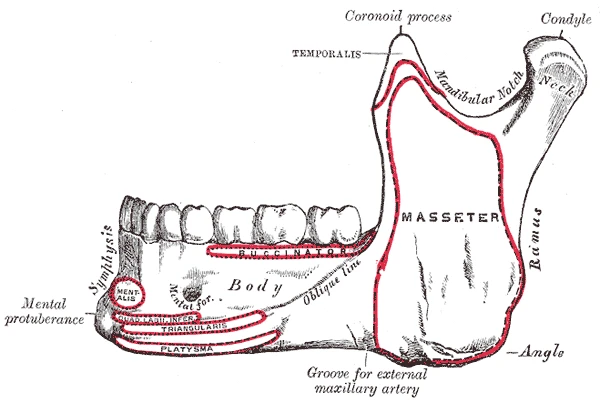 The mandible from the side, with its body, ramus, condyle and coronoid process and the attachments of muscles in red, Gray's Anatomy, 1918, figure 176Wikimedia Commons, Henry Vandyke Carter, Public domain (Gray176.png)
A plate of fibrous cartilage, the articular disc, divides each joint into an upper and a lower space. When the mouth opens a little, the condyle turns like a hinge. To open wide, the condyles and discs slide forward onto a ridge of the temporal bone. If they slide past the ridge and lock there, the jaw is dislocated.
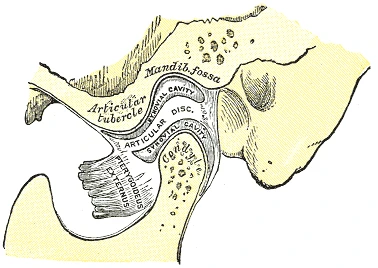 The jaw joint cut through: the articular disc lies between the condyle and its hollow, with the articular tubercle in front, Gray's Anatomy, 1918, figure 311Wikimedia Commons, Henry Vandyke Carter, Public domain (Gray311.png)
At birth the mandible is two halves joined at the chin. They fuse into one bone during the first year.
Sources
- Susan Standring (ed.), Gray's Anatomy, 42nd ed. (2020), chapters on the skull and on the infratemporal fossa and temporomandibular joint.
Prev: A newborn's soft spotsNext: 33 vertebrae