Ball, hinge and pivot
The shapes of the bone ends decide how a synovial joint moves. In a ball and socket joint, such as the shoulder and the hip, a round head turns in a cup and can swing in every direction. The shoulder's cup is shallow, so it moves more than any other joint and dislocates more often.
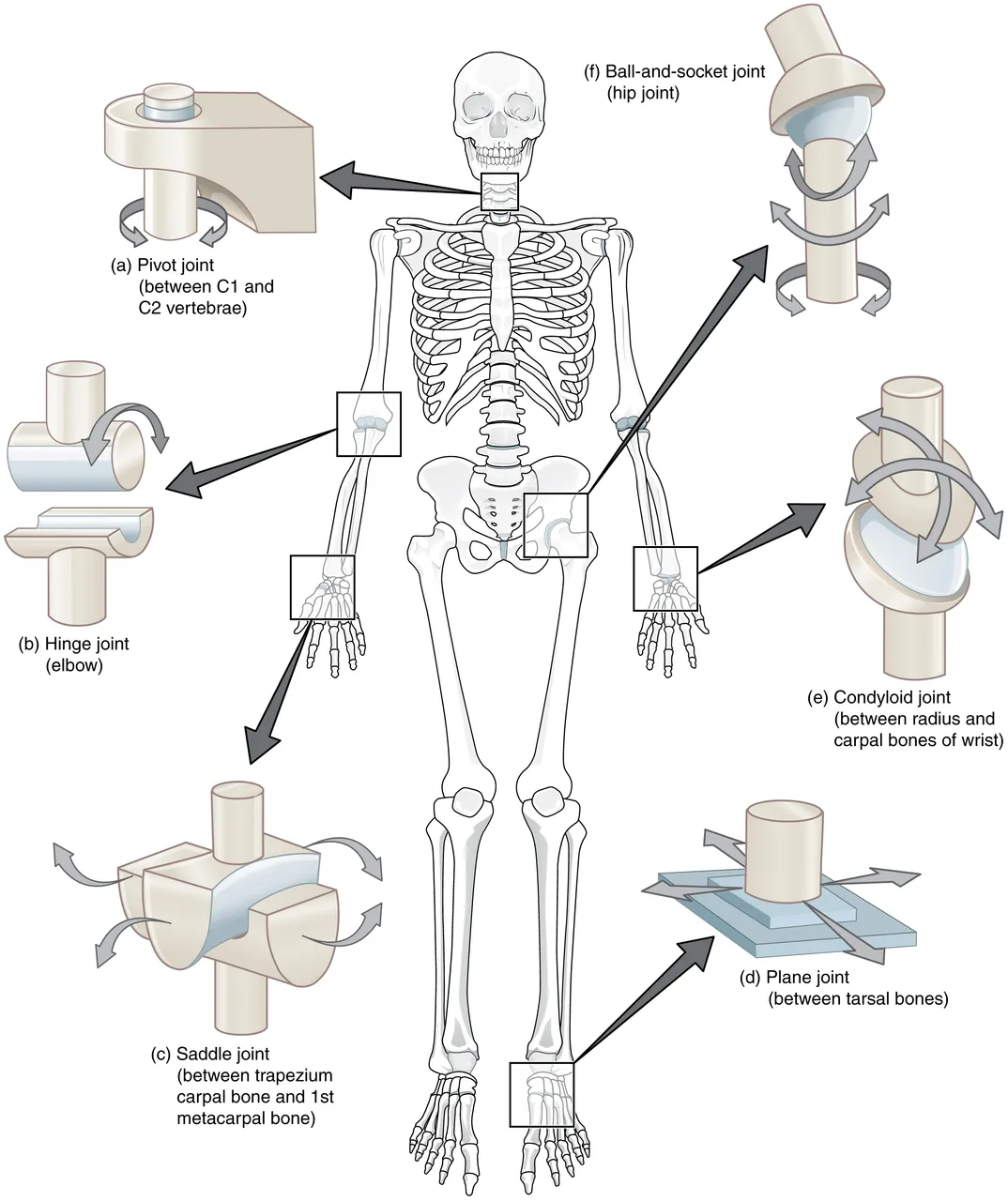 Six kinds of synovial joint: pivot, hinge, saddle, plane, condyloid, and ball and socketWikimedia Commons, OpenStax College, CC BY 3.0 (909 Types of Synovial Joints.jpg)
A hinge joint moves in one plane, like a door. The elbow is one, and so are the joints of the fingers. In a pivot joint a bone turns about its own axis. The head of the radius spins in a ring of ligament at the elbow, and the atlas turns on the peg of the axis.
Other shapes allow other movements. The saddle-shaped joint at the base of the thumb lets it swing across the palm, and the small bones of the wrist and foot glide on flat faces.
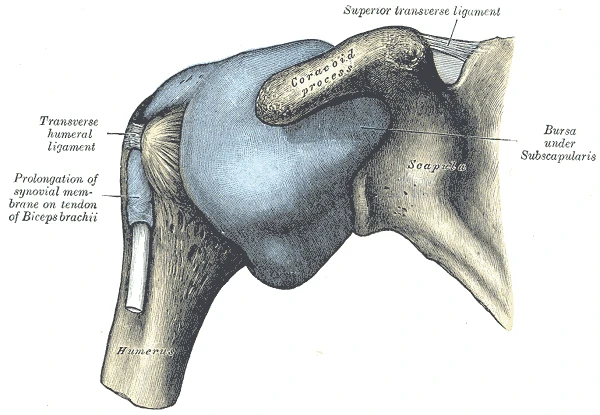 The capsule of the shoulder joint from the front, distended, Gray's Anatomy, 1918, figure 327Wikimedia Commons, Henry Vandyke Carter, Public domain (Gray327.png)
Sources
- Susan Standring (ed.), Gray's Anatomy, 42nd ed. (2020), chapters on the shoulder girdle and arm and on the elbow and forearm.
- J. Gordon Betts and others, Anatomy and Physiology (Houston: OpenStax, 2013), section 9.5.
Prev: Inside a synovial jointNext: How bones grow