The knee
The knee joins the femur to the tibia. It is the largest joint in the body and works mainly as a hinge, with a little turning when it is bent. The rounded condyles of the femur rest on the flat top of the tibia, and two C-shaped wedges of fibrous cartilage, the menisci, deepen the fit and spread the load.
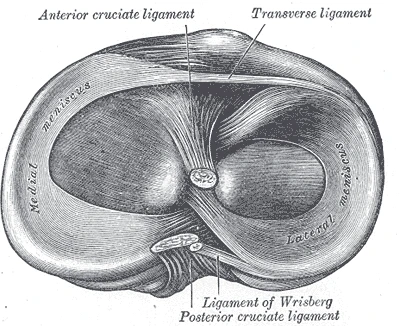 The top of the right tibia from above, with the medial and lateral menisci and the ends of the cruciate ligaments, Gray's Anatomy, 1918, figure 349Wikimedia Commons, Henry Vandyke Carter, Public domain (Gray349.png)
Inside the joint the anterior cruciate ligament and the posterior cruciate ligament cross each other. The anterior one stops the tibia sliding forward under the femur, the posterior one stops it sliding back. The collateral ligaments on each side keep the knee from bending sideways.
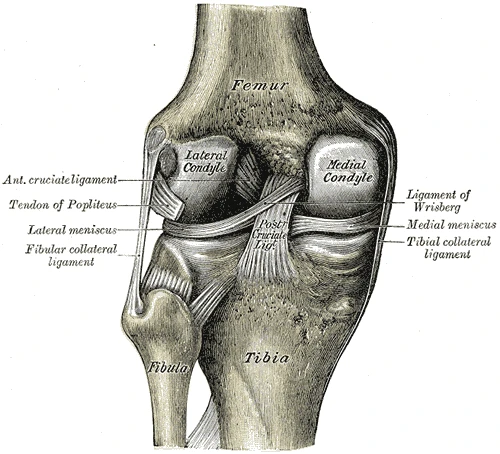 The left knee from behind, opened to show the cruciate ligaments and the menisci, Gray's Anatomy, 1918, figure 348Wikimedia Commons, Henry Vandyke Carter, Public domain (Gray348.png)
In front, the patella, the kneecap, lies in the tendon of the quadriceps, the large muscle at the front of the thigh. Holding the tendon away from the joint, it gives the muscle more leverage to straighten the knee.
Sources
- Susan Standring (ed.), Gray's Anatomy, 42nd ed. (2020), chapter on the knee.
Prev: The femurNext: Tibia and fibula