Thinning bone
Bone mass peaks around the age of 30. After that, removal slowly outpaces building. In women the loss speeds up for several years after the menopause, when oestrogen falls. In osteoporosis bone has thinned so far that it breaks in a minor fall.
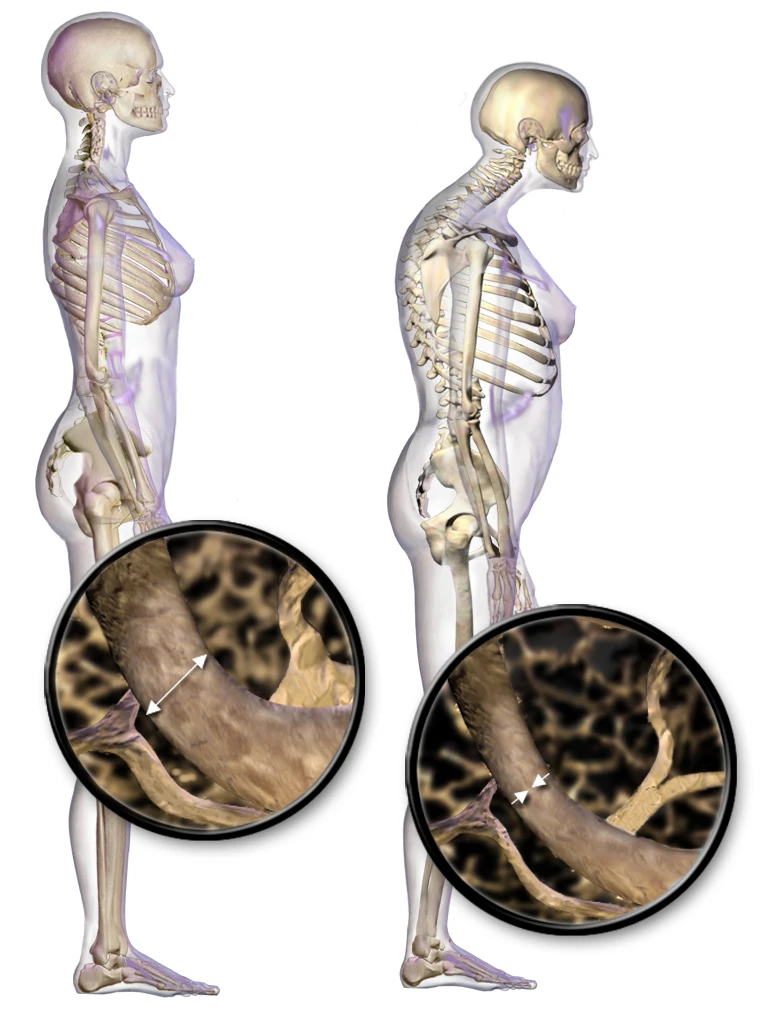 Healthy bone on the left and osteoporotic bone on the right, with thinner trabeculae and a back bent forward by collapsed vertebraeWikimedia Commons, BruceBlaus (Blausen Medical), CC BY 3.0 (Blausen 0686 Osteoporosis 01.png)
Spongy bone suffers most: its struts thin and break and the spaces widen. The typical breaks are in the bodies of the vertebrae, the neck of the femur and the lower end of the radius. Collapsed vertebrae make a person shorter and can bend the upper back forward.
Osteoporosis causes no symptoms until a bone breaks, but an X-ray scan of bone density can find it before. Exercise that loads the bones, enough calcium and vitamin D, and not smoking help keep bone, and medicines can slow the loss.
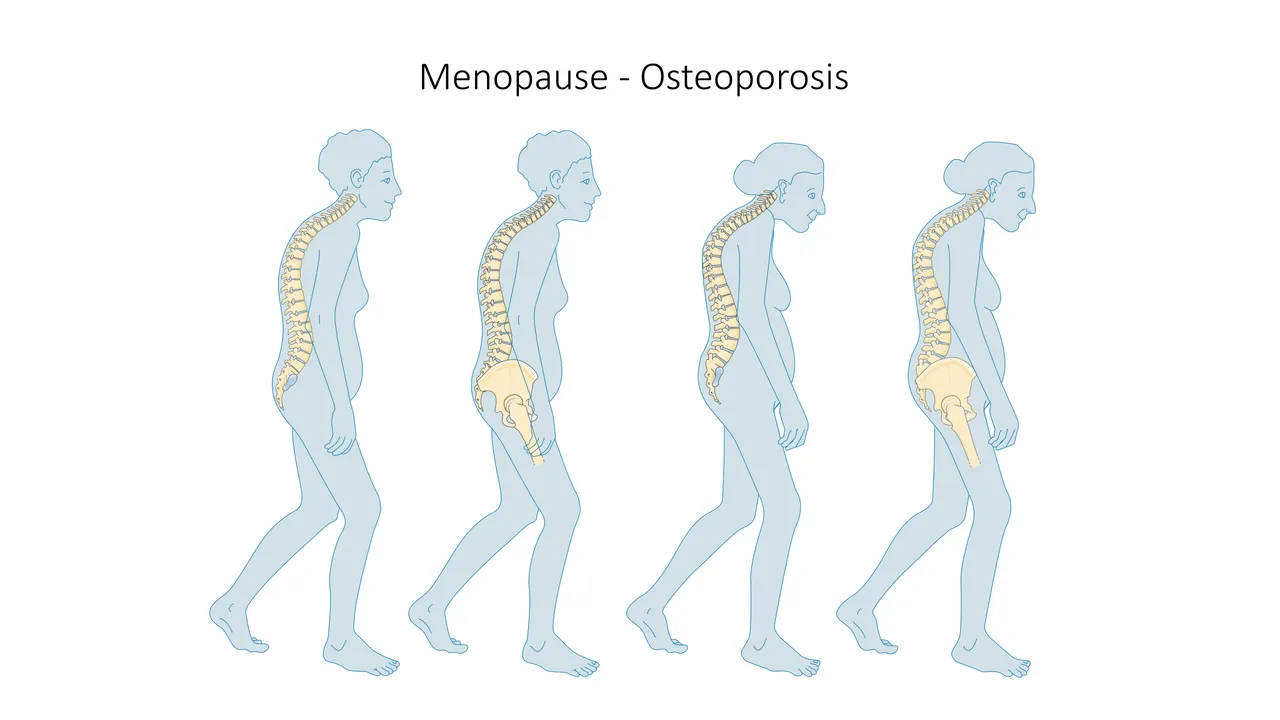 The upper back bending forward over the years as vertebrae collapse with osteoporosisWikimedia Commons, Laboratoires Servier, CC BY-SA 3.0 (Menopause - Osteoporosis -- Smart-Servier.jpg)
Sources
- Arthur Guyton and John Hall, Textbook of Medical Physiology, 13th ed. (2016), ch. 80.
- Juliet Compston, Cyrus Cooper and Eric Orwoll, Osteoporosis, The Lancet 393 (2019): 364 to 376.
Prev: A broken bone healsNext: Vesalius and the Fabrica