Twelve pairs of ribs
Twelve pairs of ribs curve forward from the thoracic vertebrae. The upper seven, the true ribs, each reach the sternum by their own costal cartilage. The false ribs, the eighth to tenth, join the cartilage of the rib above, and their cartilages are missing in this model. The last two, the floating ribs, end free in the flank.
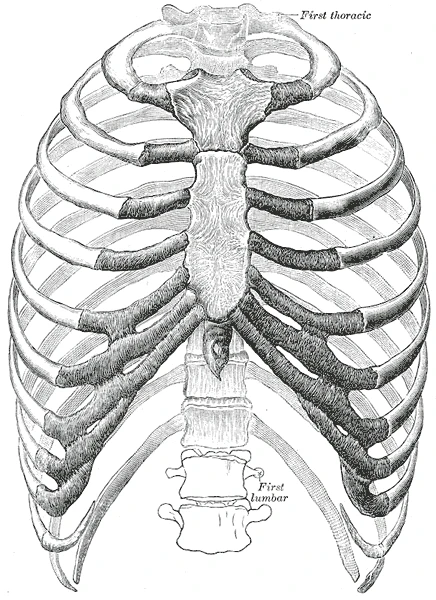 The rib cage from the front, with the costal cartilages shaded dark, Gray's Anatomy, 1918, figure 112Wikimedia Commons, Henry Vandyke Carter, Public domain (Gray112.png)
At the back each rib forms two joints with the spine, one with the vertebral bodies and one with a transverse process. Breathing in, the muscles between the ribs lift them, and they swing up and out like bucket handles, widening the chest around the lungs.
The cage shields the heart and lungs and, under its lower edge, the liver and spleen. Some people have a short extra rib above the first, a cervical rib, which can press on the nerves and artery of the arm.
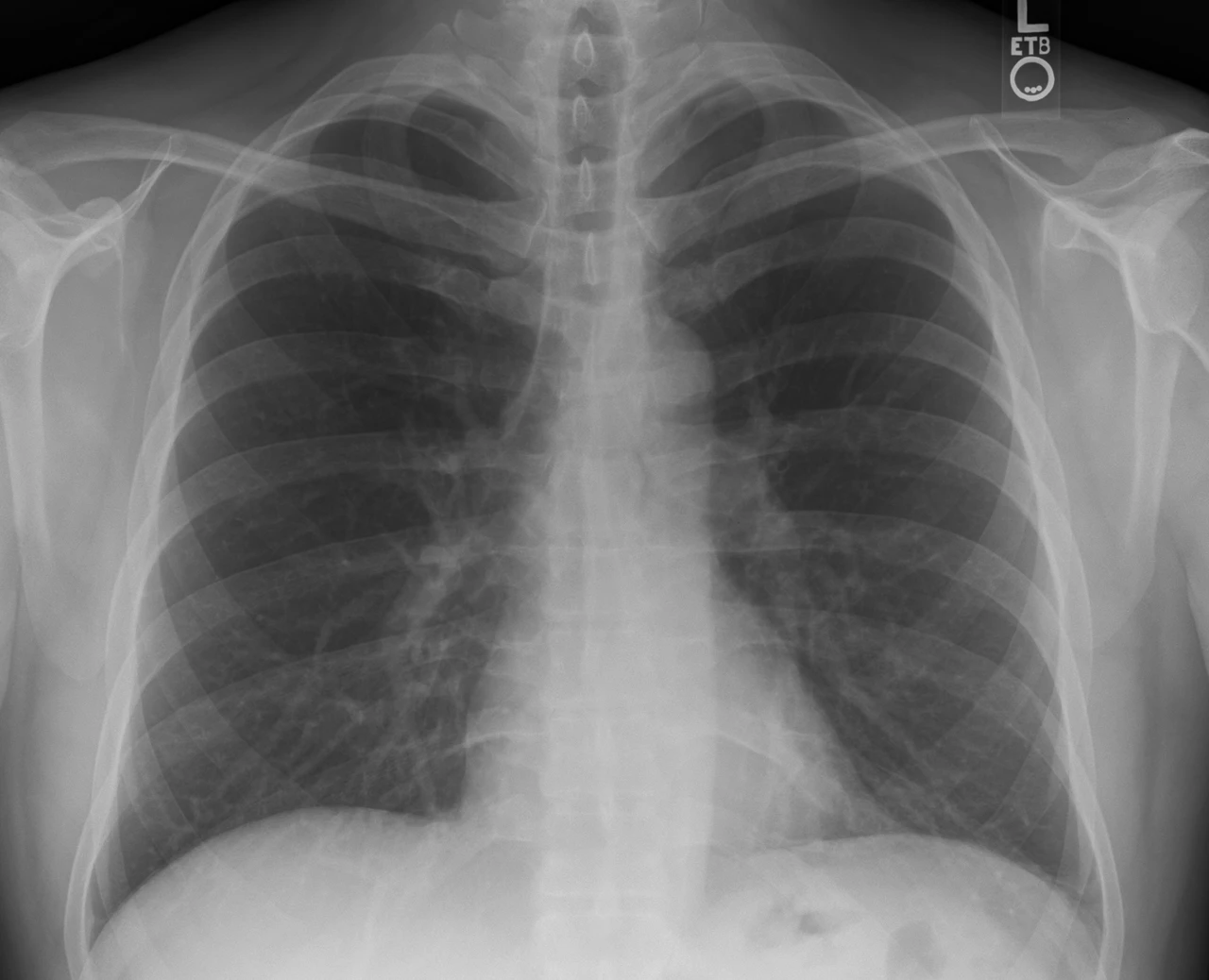 A normal chest X-ray from the front, with the ribs, the clavicles and the heart's shadow between the lungsWikimedia Commons, Stillwaterising, CC0 (Chest Xray PA 3-8-2010.png)
Sources
- Susan Standring (ed.), Gray's Anatomy, 42nd ed. (2020), chapter on the chest wall and breast.
- Arthur Guyton and John Hall, Textbook of Medical Physiology, 13th ed. (2016), ch. 38.
Prev: A slipped discNext: The sternum