A slipped disc
With age the outer ring of a disc dries and can tear. The nucleus can then bulge or push out through the tear, which is called a herniated or slipped disc. In the lower back this most often happens at the disc between the fourth and fifth lumbar vertebrae, shown cut across here, or at the one below it.
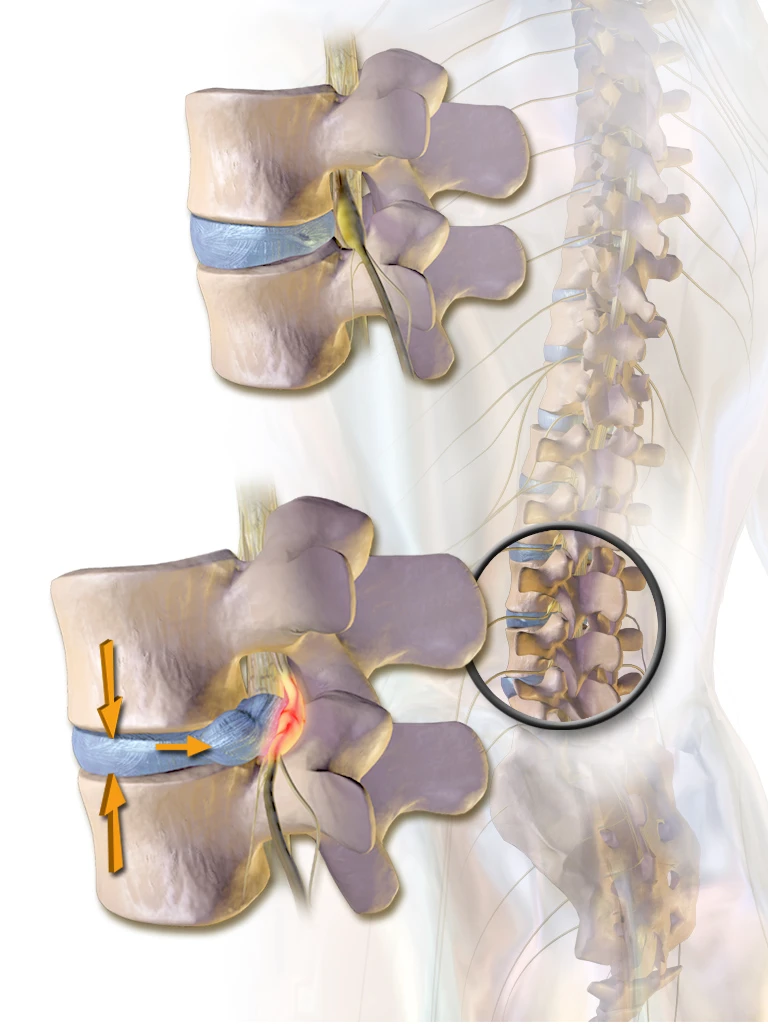 A healthy disc above and a herniated disc below, which bulges backward onto a nerve rootWikimedia Commons, BruceBlaus (Blausen Medical), CC BY 3.0 (Herniated Disc.png)
The nucleus usually breaks out backward and to one side, beside the posterior longitudinal ligament, which runs down the backs of the discs and is narrow in the lower back. There it presses on the nerve roots of the cauda equina where they leave the canal.
Pressure on these roots causes sciatica, pain that runs from the buttock down the back of the leg, sometimes with numbness or weakness. In most people it eases within weeks to a few months without surgery.
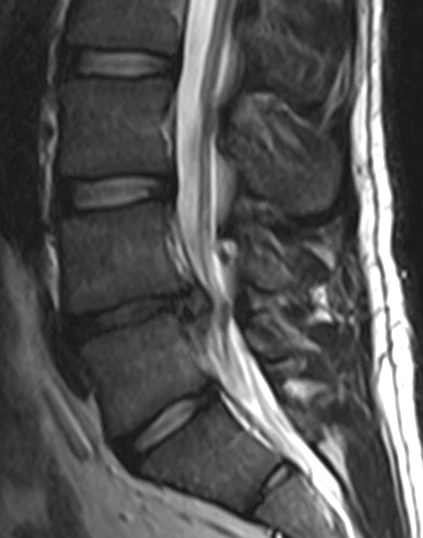 MRI of the lower back from the side: the disc between the fourth and fifth lumbar vertebrae has pushed backward into the spinal canalWikimedia Commons, Edave, CC BY-SA 3.0 (L4-l5-disc-herniation.png)
Sources
- Susan Standring (ed.), Gray's Anatomy, 42nd ed. (2020), chapter on the back.
- Allan Ropper and Ross Zafonte, Sciatica, New England Journal of Medicine 372 (2015): 1240 to 1248.
Prev: The discsNext: Twelve pairs of ribs