The sternum
The sternum, the breastbone, is a flat bone about 17 cm long in the front of the chest. It has three parts: the manubrium at the top, which carries the clavicles and the first ribs, the long body, and the small xiphoid process at the bottom. The xiphoid is cartilage in youth and turns to bone in middle age.
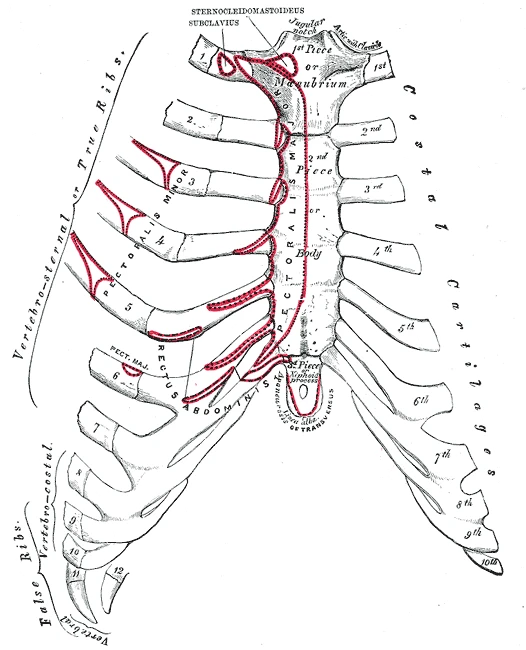 The sternum and costal cartilages from the front, with the attachments of muscles in red, Gray's Anatomy, 1918, figure 115Wikimedia Commons, Henry Vandyke Carter, Public domain (Gray115.png)
The manubrium meets the body at a slight angle, which you can feel as a ridge. The second ribs join the sternum there, so doctors count the ribs from it. The costal cartilages let the ribs spring as the chest moves, and they tend to calcify with age.
The sternum lies over the heart. In resuscitation, pressing it down 5 to 6 cm, 100 to 120 times a minute, squeezes blood out of the heart and keeps it flowing to the brain.
Sources
- Susan Standring (ed.), Gray's Anatomy, 42nd ed. (2020), chapter on the chest wall and breast.
- Gavin Perkins and others, European Resuscitation Council Guidelines 2021: adult basic life support, Resuscitation 161 (2021): 98 to 114.
Prev: Twelve pairs of ribsNext: The shoulder girdle