Three kinds of joint
A joint is a place where bones meet, and anatomists sort joints by what holds the bones together. In fibrous joints it is dense fibrous tissue, and the bones barely move. The sutures of the skull are fibrous joints, and so is the lower joint between the tibia and the fibula.
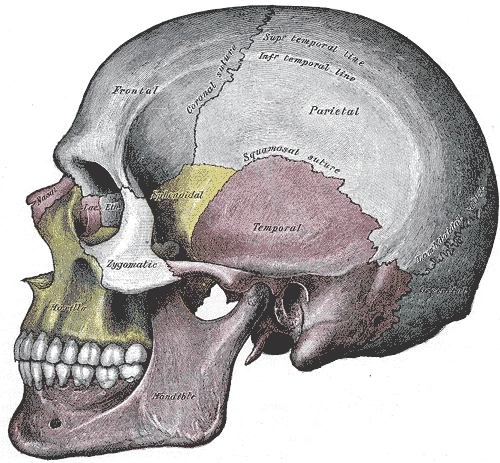 The skull from the side, with the coronal and squamosal sutures, Gray's Anatomy, 1918, figure 188Wikimedia Commons, Henry Vandyke Carter, Public domain (Gray188.png)
In cartilaginous joints a pad of cartilage joins the bones and lets them move a little. The intervertebral discs and the pubic symphysis join bones in this way.
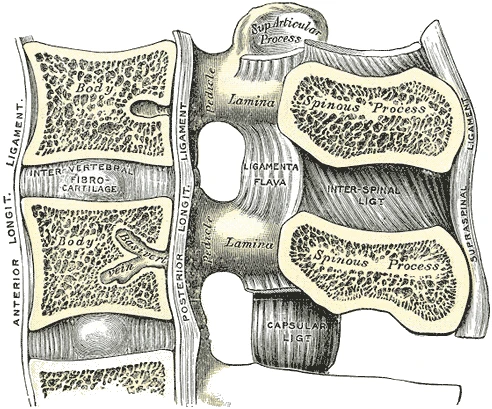 Two lumbar vertebrae cut down the middle, with the disc between their bodies and the ligaments of the column, Gray's Anatomy, 1918, figure 301Wikimedia Commons, Henry Vandyke Carter, Public domain (Gray301.png)
Most joints of the limbs are synovial joints. The ends of the bones are free to move on each other inside a capsule of fibrous tissue, as in the shoulder, the elbow, the hip and the knee.
Sources
- Susan Standring (ed.), Gray's Anatomy, 42nd ed. (2020), chapter on the functional anatomy of the musculoskeletal system.
- J. Gordon Betts and others, Anatomy and Physiology (Houston: OpenStax, 2013), sections 9.1 to 9.4.
Prev: The arches of the footNext: Inside a synovial joint