1543
Vesalius and the Fabrica
In 1543 Andreas Vesalius, a 28-year-old professor of anatomy at Padua, published De humani corporis fabrica, On the fabric of the human body, in Basel. Its woodcuts showed the body in more detail and more correctly than any earlier book. The first of its seven books covers the bones.
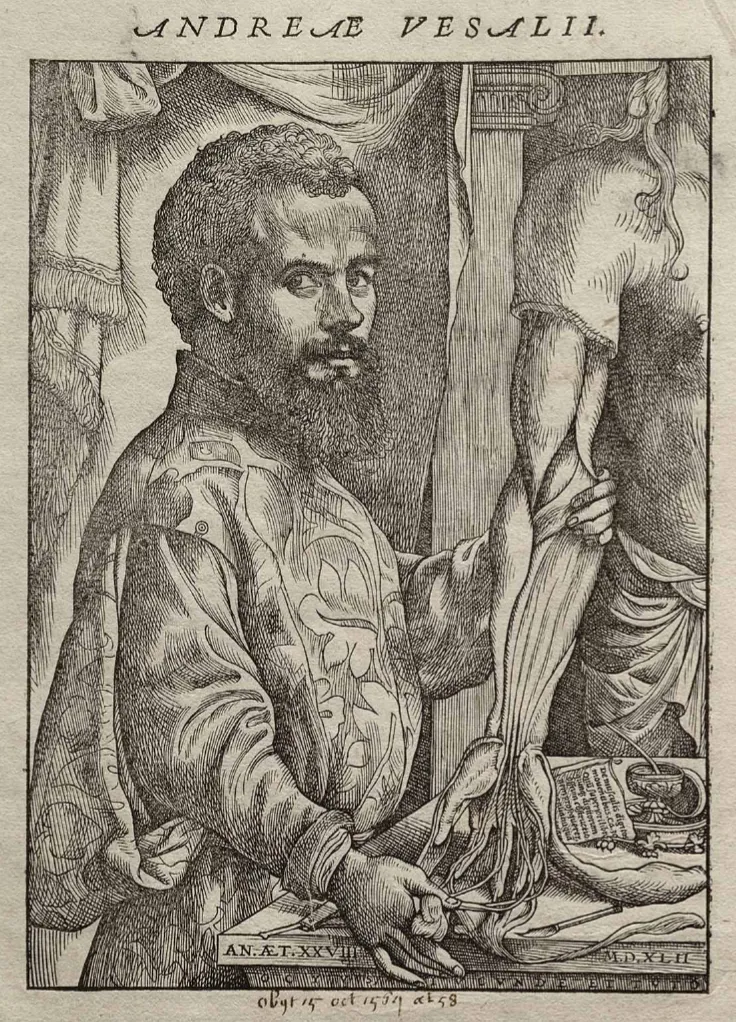 Andreas Vesalius at 28, from the Fabrica, 1543Wikimedia Commons, attributed to Jan van Calcar, Public domain (Vesalius Fabrica portrait.jpg)
Anatomy until then rested on Galen, a Greek physician of the second century who had dissected animals. Vesalius dissected human bodies himself and found where Galen's account did not fit them. In humans the mandible is one bone, not two, and the sternum has three parts, not seven.
Three full-page woodcuts show the skeleton from the front, the side and the back. In the side view the skeleton leans on a tomb, one hand resting on a skull, as if in thought.
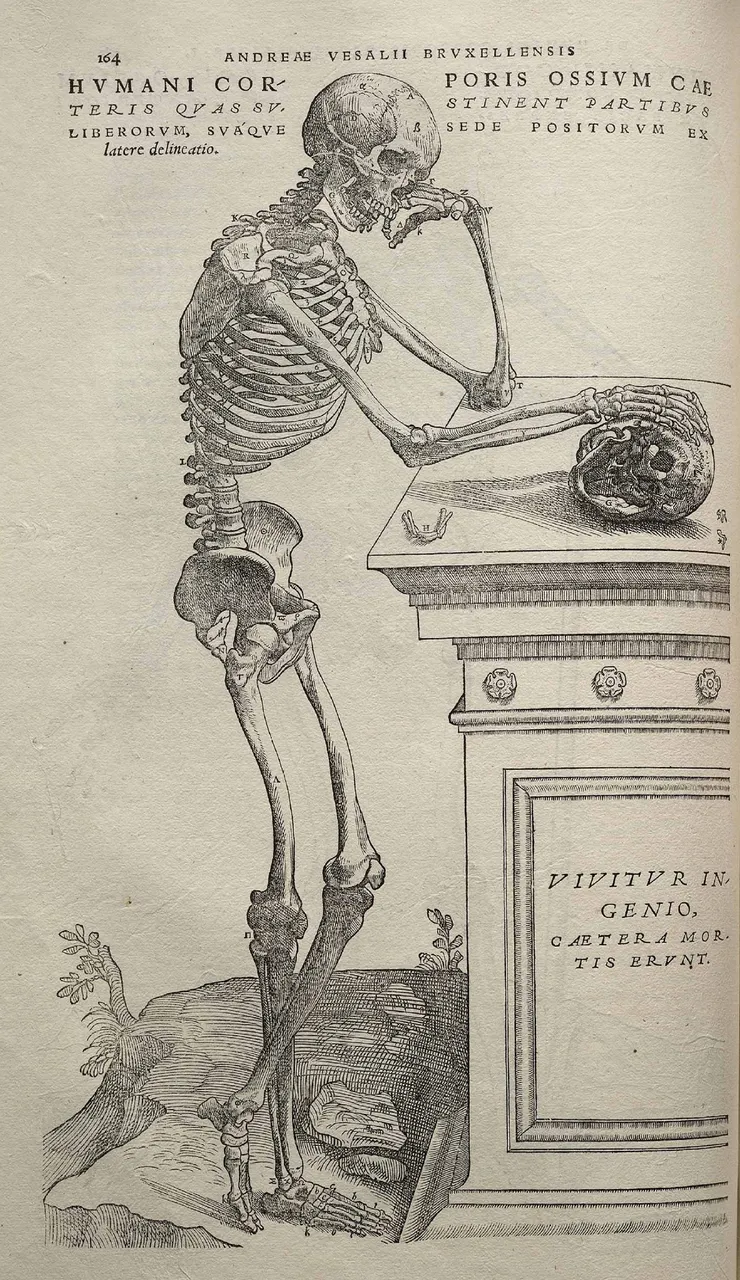 The skeleton from the side, leaning on a tomb with one hand on a skull, from the Fabrica, 1543Wikimedia Commons, Andreas Vesalius, Public domain (Vesalius Fabrica p164.jpg)
Sources
- Andreas Vesalius, De humani corporis fabrica libri septem (Basel: Johannes Oporinus, 1543), book 1.
- Charles O'Malley, Andreas Vesalius of Brussels, 1514 to 1564 (Berkeley: University of California Press, 1964).
Prev: Thinning boneNext: Röntgen's rays